
Padel Balls vs Tennis Balls: What's the Difference and Does It Actually Matter?
LEARN
6/7/20266 min read
Padel Balls vs Tennis Balls: What's the Difference and Does It Actually Matter?
If you're new to padel, this question probably crossed your mind at some point. The two balls look almost identical sitting next to each other. Same size, same felt, same rough texture. So what's the big deal?
The answer is more important than most beginners realise — and using the wrong ball, even once, will make the game feel noticeably different. Here's everything you need to know.
Are Padel Balls and Tennis Balls the Same?
Short answer — no.
Long answer — they're close enough to confuse anyone who hasn't been told the difference, but different enough that substituting one for the other changes how the game plays entirely.
Both balls are hollow, pressurised, and covered in felt. Both sit at around 6.35–6.77cm in diameter. From ten feet away you genuinely cannot tell them apart.
But the difference is in the internal pressure — and in padel, pressure changes everything.
The Key Technical Difference
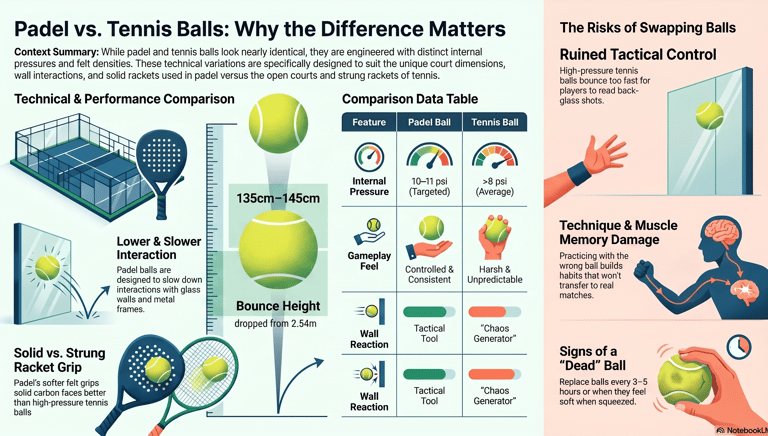
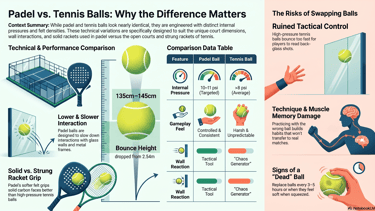
Padel balls are manufactured at a lower internal pressure than tennis balls. Specifically:
Tennis balls: Around 12-14 pounds per square inch (psi) internal pressure on average.
Padel balls: Around 9-11 psi — but with a softer felt and slightly lower bounce specification designed for an enclosed glass court.
That difference in pressure and felt density is what gives padel balls their characteristic feel — a slightly slower, more controlled bounce that suits the enclosed court environment padel is played in.
On a padel court, the ball is constantly interacting with glass walls and a metal frame. A standard tennis ball at full pressure would bounce off those surfaces too fast, too unpredictably, and would make the game almost unplayable at club level.
The padel ball is engineered to slow that interaction down just enough to make the glass a tactical tool rather than a chaos generator.
How They Feel Differently On Court
This is where it gets practical.
Bounce height and speed
Hit a padel ball and a tennis ball against the same wall from the same distance and the difference becomes immediately obvious. The tennis ball comes back faster and higher. The padel ball returns lower and slower — which is exactly what you want when you're trying to read and react to a back glass shot in a real match situation.
At club level, that fraction of a second of extra time is the difference between a comfortable reset and a panic mishit.
Feel on the racket
Padel rackets have no strings — they're solid carbon or fibreglass faces with holes punched through them. That surface interacts very differently with a ball than a strung tennis racket does.
A tennis ball at full pressure hitting a solid padel face feels harsh and unpredictable. A padel ball at lower pressure feels controlled and consistent. The engineering of both the racket and the ball is designed to work together — swap one out and the whole system feels slightly wrong.
Spin and trajectory
Padel balls are designed to take spin well — which matters enormously in a sport where the vibora, bandeja, and lob are all spin-dependent shots. The slightly softer felt grips the face of a padel racket on contact in a way that makes these shots more controllable and consistent.
Try generating a clean vibora with a tennis ball on a padel racket and you'll immediately notice the difference. The ball slips off the face rather than gripping it.
Can You Use Tennis Balls for Padel?
Technically yes. Practically — you really shouldn't.
If you're in a pinch, in a garden, or just knocking about informally, a tennis ball won't break anything. But for any serious practice or match play, using a tennis ball on a padel court creates three specific problems:
1. The bounce is too high
Standard tennis balls bounce higher than padel rules allow. The official padel bounce specification requires a ball dropped from 2.54 metres to rebound between 135–145cm. Most tennis balls exceed this — which means the game becomes faster, more chaotic, and rewards power over the tactical control that makes padel interesting.
2. The back glass becomes unpredictable
One of padel's defining features is the tactical use of the back and side glass. Experienced players deliberately play balls into the back glass to create difficult angles. This only works because the padel ball's pressure and felt is calibrated for those surfaces.
A tennis ball bouncing off back glass at higher speed gives your opponent significantly less time to read and react — removing a huge part of what makes padel tactically interesting at club level.
3. Your technique development suffers
If you're a beginner or intermediate player using tennis balls in practice, you're essentially training for a slightly different sport. The timing, positioning, and shot selection you develop around a tennis ball won't transfer cleanly to match play with a proper padel ball.
This matters more than most people appreciate. Muscle memory built on the wrong ball is muscle memory you'll have to undo later.
Can You Use Padel Balls for Tennis?
You can — but you'll notice immediately that something feels off.
Padel balls are too soft for the power levels in tennis. On a strung tennis racket, the lower pressure means the ball compresses more on impact, loses energy through the string bed, and sits shorter and slower than a tennis ball would.
For casual garden tennis this doesn't matter much. For any serious tennis practice it would actively interfere with your development in the same way using a tennis ball interferes with padel practice.
The two sports have evolved their equipment in parallel — and they're not interchangeable in either direction.
How Long Do Padel Balls Last?
This is a question that doesn't get asked enough — and the answer affects every padel player's game whether they realise it or not.
Padel balls lose pressure over time. Once a can is opened, the balls begin to slowly depressurize regardless of how much they're used. Most serious players notice a difference in bounce and feel after around three to five hours of play — sometimes sooner on warm, humid days when the felt absorbs moisture.
At club level, most organised sessions use balls that have been opened for days or even weeks. It's worth knowing what a fresh ball feels like so you can calibrate your expectations — a flat, tired padel ball bounces noticeably lower and responds less predictably off the glass.
Signs your padel balls need replacing:
→ The bounce feels noticeably low
→ The ball feels soft when squeezed
→ Back glass shots are sitting shorter than expected
→ The felt is visibly worn smooth in patches
Serious players bring their own fresh balls to practice sessions for exactly this reason.
Which Padel Balls Should You Buy?
Not all padel balls are equal — and the difference between a budget ball and a quality one is more noticeable than most beginners expect.
For club-level recreational play, here's what to look for:
Pressurised vs pressureless
Most padel balls are pressurised — sealed in a pressurised can to maintain their internal pressure until opened. These are what you want for match play and serious practice.
Pressureless balls exist but are typically used for ball machines or practice drills where longevity matters more than feel.
Approved balls for competition
If you play in any organised competition the balls used must be approved by the International Padel Federation (FIP). The most common approved brands at club level in the UK are:
Any of these are a solid choice for regular club play.
The Bottom Line
Padel balls and tennis balls look almost identical but are engineered for completely different purposes. The difference in internal pressure, felt density, and bounce specification might seem minor on paper — but on court it changes the entire feel of the game.
Use the right ball, replace them regularly, and you'll get a consistently better experience every time you step on court.
It's one of those small details that separates players who understand the sport from players who are still figuring it out.
Found this useful? Subscribe to the Club Padel & Co newsletter for weekly guides, racket reviews, and tactical tips for everyday players.
Recommended for you
Best Padel Racket for Beginners


