How to Choose a Padel Racket (Complete Buying Guide)
LEARN
12/7/20255 min read
Choosing the right padel racket can have a big impact on how quickly you improve, how comfortable you feel on court, and how much fun you have while playing. With so many shapes, weights, materials, and balance points, it can feel overwhelming — especially if you’re new to the sport.
This complete buying guide breaks down everything you need to know — from racket shape and balance to weight, materials, and playing style — so you can confidently pick the right padel racket for your level and goals.
Why Choosing the Right Racket Matters
Unlike tennis or squash — where the racket’s strings define much of the feel — a padel racket’s shape, materials, core and balance fundamentally shape how the ball responds and how the racket feels in your hand.
The right racket can:
Improve consistency and control
Reduce injury and fatigue
Boost confidence during rallies
Support long-term skill development
Choosing a racket that doesn’t suit your level or style can slow your progress and make the game feel harder than it needs to be.
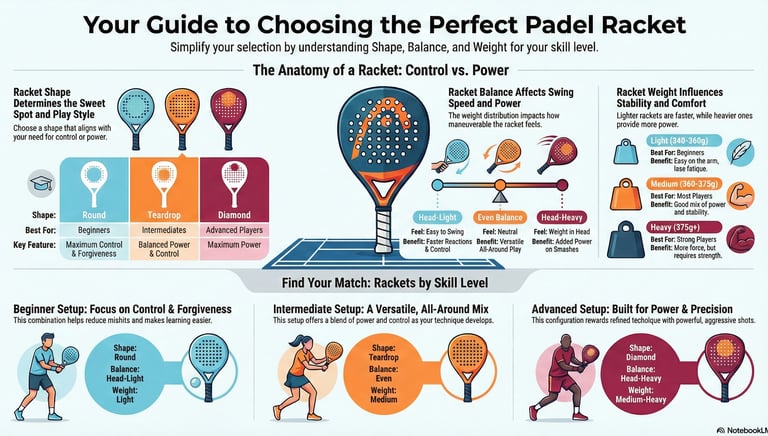
1. Racket Shape — The Foundation of Performance
One of the most important decisions is the shape of your padel racket, because it influences power, control, and where the racket’s sweet spot sits.
Round Shape
Best for: Beginners & control-focused players
Key features: Largest sweet spot, most forgiving
Play style: Defensive, accuracy, long rallies
Round rackets have a centred sweet spot and tend to be easier to control. They’re ideal if you’re just starting out and want predictable performance that helps reduce mishits.
Teardrop Shape
Best for: Intermediate players
Key features: Balanced between power and control
Play style: All-around play, adaptable tactics
Teardrop rackets offer a good mix of power and control. They place the sweet spot slightly higher than round rackets, giving you more natural power while retaining decent forgiveness.
Diamond Shape
Best for: Advanced players
Key features: Maximum power, smaller sweet spot
Play style: Aggressive attacking, finishing shots
Diamond rackets put more weight towards the head and offer higher power potential, but are less forgiving on off-centre hits. They reward accuracy and strength, and are best suited to players with refined technique.
2. Balance & Feel — Manoeuvrability vs Power
Once you understand shape, the next thing to consider is balance, which describes how the racket’s weight is distributed.
Head-Light (Low Balance)
Feel: Easy to swing
Benefits: Excellent control, faster reactions at the net
Best for: Beginners, defensive players
Head-light rackets feel lighter in the head and are easier to manoeuvre. This makes them ideal if you prioritise control and comfort over raw power.
Even Balance (Medium Balance)
Feel: Balanced mix of control and power
Benefits: Versatile performance
Best for: All-around players
A neutral or even balance gives a good blend of power and control, making teardrop rackets with even balance a favourite for intermediate players.
Head-Heavy (High Balance)
Feel: Weight towards the head
Benefits: Added power on smashes and overheads
Best for: Advanced, offensive players
Head-heavy rackets deliver strong power generation but can feel sluggish in quick exchanges if you’re still building technique.
3. Weight — Stability, Speed & Comfort
The weight of your padel racket significantly shapes how it feels and performs. Most adult rackets fall between 340g and 380g, but even small differences can matter.
Lightweight Rackets (340–360g)
Feel: Easy to move quickly
Benefits: Great manoeuvrability and less fatigue
Best for: Beginners, players with smaller physique or injury concerns
Lighter rackets are ideal if you’re new to padel because they’re easier on your arm and help you react faster.
Medium Weight (360–375g)
Feel: Balanced stability and control
Benefits: Good power without too much strain
Best for: Most intermediate players
This range offers a healthy compromise between control and power, suiting a wide range of players.
Heavier Rackets (375g+)
Feel: More stable on impact
Benefits: Increased power potential
Best for: Stronger, advanced players
Heavier rackets can generate more force but require good technique and strength to avoid fatigue and injury.
4. Materials — Power, Control & Durability
The materials used in a padel racket determine how it feels and performs on court. Most rackets combine multiple materials on the core, frame, and striking surface.
Frame & Face Materials
Carbon Fibre
Strong and stiff
Provides excellent power and precision
Common in mid-to-high-end rackets
Fibreglass
Softer and more forgiving
Better for beginners and comfort-focused players
Often found in entry-level rackets
Hybrid / Graphene
Combines benefits of both carbon and fibreglass
Offers improved strength, lighter weight, and faster response in premium rackets
Core Materials
EVA Foam
Standard in most rackets
Comes in soft to hard densities
Softer EVA = comfort and control
Harder EVA = greater power and speed
Polyethylene / Soft Foam
Softer feel
Increased shock absorption
Ideal for comfort and beginners
The right combination of materials will depend on your priorities — comfort and control, power and responsiveness, or a balance of both.
5. Grip & Comfort — What You Feel in Your Hand
While often overlooked, grip size and comfort matter a lot. A grip that’s too small or too large can lead to discomfort or even injury. Most rackets come with a standard grip size, but you can tailor it with overgrips or replacement grips to find your perfect fit.
Use a grip size that lets you comfortably curl your fingers around the handle without tension — not too tight and not so loose that you lose control on volleys or smashes.
6. Match Your Racket to Your Playing Style
Now that you understand the core specs, the final piece of the puzzle is to match your racket to your playing style and goals.
Beginners
If you’re just starting out:
Shape: Round
Weight: Light to medium
Balance: Head-light or even
Core: Soft or medium EVA
Materials: Fibreglass or mix
This combination prioritises control, comfort, and forgiveness, reducing the impact of off-centre hits.
Intermediate Players
As your technique develops:
Shape: Teardrop
Weight: Medium
Balance: Even
Core: Medium EVA
Materials: Carbon/fibreglass combo
This setup gives you a good mix of power and control without overwhelming your game.
Advanced Players
If you have refined technique:
Shape: Diamond (or advanced teardrop)
Weight: Medium to slightly heavy
Balance: Medium-high or head-heavy
Core: Harder EVA
Materials: High-end carbon or graphene
This configuration supports powerful shots, aggressive play, and tactical precision — but demands good timing and skill.
Final Tips Before You Buy
Try Before You Decide: Demoing rackets, if possible, lets you feel the balance and swing first hand.
Don’t Over-Chase Specs: The highest power racket isn’t always better — especially if you’re still mastering technique. Choose comfort and control first.
Upgrade Strategically: As your game improves, you can adjust shape, balance, and materials to suit your evolving style.
Recommended for you
Best Padel Racket for Beginners