Padel Techniques & Shots Guide
LEARN
12/8/20256 min read
Padel Techniques & Shots Guide (Complete Player Handbook)
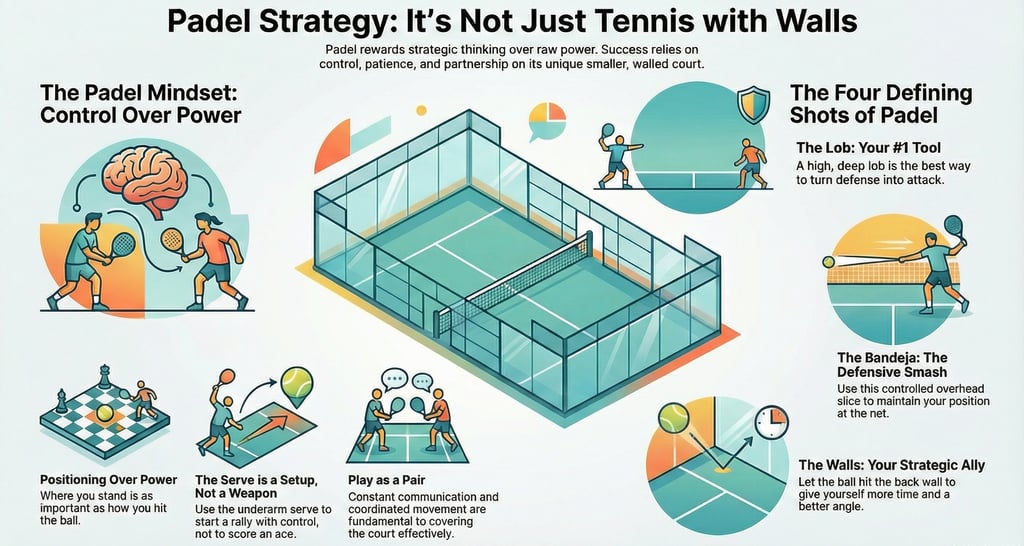
Padel is often described as one of the easiest racket sports to pick up — and that’s true. Most players can rally within their first session. But progressing beyond the beginner stage is where padel really reveals its depth. Unlike tennis, power alone won’t get you far. Instead, padel rewards control, positioning, patience, and intelligent shot selection.
This complete padel techniques and shots guide explains the key skills every player needs to understand. From groundstrokes and volleys to lobs, smashes, and wall play, this guide will help you build a solid technical foundation and improve your game step by step.
The Fundamentals of Padel Technique
Before focusing on individual shots, it’s important to understand what makes padel unique. The court is smaller, the walls are in play, and points are often constructed slowly rather than finished quickly. Successful padel players learn to defend well, wait for the right opportunity, and work with their partner rather than trying to dominate rallies alone.
Good technique in padel is built on balance, preparation, and consistency. Compact swings are far more effective than big, powerful motions, and knowing where to stand is often just as important as knowing how to hit the ball.
Ready Position and Court Positioning
Everything in padel starts with positioning. A good ready position allows you to react quickly and stay balanced throughout the rally. Knees should be slightly bent, your weight should be forward, and the racket should be held comfortably in front of your body using a continental grip.
Court positioning is equally important. When defending, both players should stay back near the baseline and move together. When attacking, the aim is to take control of the net as a pair. One of the most common beginner mistakes is advancing alone or failing to recover to the middle of the court after hitting a shot. Staying connected with your partner keeps the court covered and reduces easy errors.
Forehand and Backhand Groundstrokes
Forehands and backhands in padel form the backbone of long rallies. Unlike tennis, padel groundstrokes rely on short, controlled swings rather than full follow-throughs. Contact should be made in front of the body, with an emphasis on placement rather than speed.
The forehand is usually the more natural side for most players, but it still requires restraint. Overhitting leads to unforced errors, especially when the glass comes into play. The backhand can be played with one or two hands, and both options are valid. Two-handed backhands often provide more stability for beginners, while one-handed backhands offer greater reach and finesse once confidence improves.
The Padel Serve
The serve in padel is deliberately limited, which helps keep rallies competitive. It must be hit underarm, below waist height, after the ball has bounced on the ground. Because of this, the serve is not a weapon but a way to start the point with control.
A good padel serve focuses on consistency and placement. Many players aim for the opponent’s backhand and use slice to keep the ball low after it bounces. Trying to hit aces or overpower the return usually leads to faults. Instead, a reliable serve that allows you and your partner to move forward is far more valuable.
Returning the Serve
The return of serve is one of the most important moments in a padel rally. A strong return can immediately neutralise the serving team and give you the chance to take the net.
Rather than attacking the return, most players benefit from blocking the ball back with control and aiming deep into the court. If the serve is strong, a lob can be an excellent option, pushing opponents back and buying time to advance. The key objective is not to win the point outright, but to avoid giving the serving team an easy volley.
Volleys and Net Control
Net play is where padel points are most often decided. Once at the net, volleys should be compact, controlled, and precise. Big swings are unnecessary and risky. Instead, players use a short punching motion, keeping the racket head stable and directing the ball into awkward spaces.
Effective volleying is about applying pressure. Playing low balls towards opponents’ feet, aiming into the middle to reduce angles, and remaining patient will force mistakes over time. Players who rush to finish points too early often end up losing net position and control of the rally.
The Bandeja
The bandeja is one of the most important shots to learn when moving beyond beginner level. It is a controlled overhead shot designed to keep you at the net rather than end the point.
When executing a bandeja, players adopt a side-on stance and use a slicing motion to send the ball deep into the opponent’s court. The objective is height, depth, and control. This shot is typically used when the lob is too good to smash but too short to retreat and defend comfortably.
Mastering the bandeja allows players to maintain offensive positioning and avoid being pushed back unnecessarily.
The Vibora
The vibora is a more aggressive variation of the bandeja. It is hit with greater speed and side spin, producing a lower and faster trajectory. While the bandeja focuses on safety, the vibora adds pressure and can force weak returns.
This shot is best used when the lob is slightly shorter and you have good balance. Because it carries more risk, it is usually developed at intermediate and advanced levels, once timing and footwork are consistent.
Smashes in Padel
Smashing in padel is often misunderstood, especially by players with a tennis background. While power can be effective, smashing recklessly usually leads to lost points.
There are several types of smashes in padel. Flat smashes can be used on very short lobs but require precision. Topspin smashes, often referred to as “X3” smashes, are designed to send the ball out of the court after it hits the back wall. These require advanced technique and strength. Wall-assisted smashes, where the ball rebounds off the glass, are a smart alternative when outright winners are not possible.
The key is discretion. Smart padel players choose their smashes carefully.
The Importance of the Lob
If there is one shot that defines padel, it is the lob. A consistent, well-placed lob can turn defence into attack and disrupt even the strongest opponents.
Good lobs are built on height and control rather than speed. The aim is to push opponents back, create space at the net, and force weaker overhead shots. Many rallies are decided not by smashes, but by who lobs better and positions themselves more intelligently afterwards.
Playing Off the Walls
The glass walls are what truly separate padel from other racket sports. Learning to use them effectively takes time, but they offer a huge advantage once understood.
When defending, it’s often better to let the ball bounce off the back wall rather than rushing forward. This gives you more time and a more comfortable hitting position. Side walls are more unpredictable and require softer hands and better judgement. Patience is crucial when dealing with wall rebounds.
Defence and Recovery
Strong defence is a hallmark of good padel players. Defensive shots are rarely flashy, but they keep you in the point and create opportunities to regain control.
Soft blocks, controlled cross-court shots, and well-timed lobs are essential defensive tools. After each defensive shot, players should recover to a neutral position and move forward together when the opportunity arises. Good defence often leads directly to attack.
Team Play and Communication
Padel is a doubles-only sport, and communication is fundamental. Calling shots, deciding who takes lobs, and moving as a pair all contribute to consistency and confidence on court.
Teams that communicate well often outperform technically stronger pairs who play as individuals.
Final Thoughts
Padel is not about hitting harder — it’s about thinking smarter. By focusing on technique, positioning, and decision-making, players can improve quickly and enjoy the game far more.
This guide provides a complete overview of the essential padel techniques and shots. As your skills develop, each of these areas can be explored in more detail, but mastering the basics will always be the foundation of good padel.
Recommended for you
Best Padel Racket for Beginners