
What Is the Difference Between Padel and Pickleball?
LEARN
3/4/20264 min read
What Is the Difference Between Padel and Pickleball?
Padel and pickleball are two of the fastest-growing racket sports in the world. If you’ve recently discovered one of them, you’ve probably wondered how they compare.
At first glance they might look similar: both are social, easy to learn, and played on smaller courts than tennis. But once you step on court, the experience is very different.
In this guide we’ll break down the key differences between padel and pickleball, including the court, rules, equipment, and which sport might suit you best.
What Is Padel?
Padel is a racket sport usually played in doubles on an enclosed court surrounded by glass walls and metal fencing.
The key feature of padel is that the walls are part of the game, similar to squash. After the ball bounces, it can rebound off the glass and still be played.
This creates longer rallies and adds a tactical element where players use the walls to defend and build points.
Key characteristics of padel
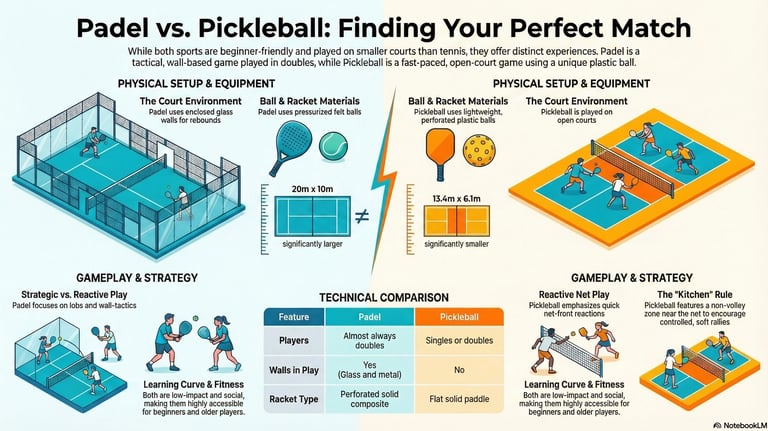
Played on a 20m x 10m enclosed court
Always played in doubles
Uses padel rackets with no strings
Ball is similar to a tennis ball but slightly lower pressure
Walls can be used during play
Because of the walls and smaller court, padel focuses heavily on positioning, teamwork, and tactics rather than power.
What Is Pickleball?
Pickleball is a paddle sport played on a smaller open court, roughly the size of a badminton court.
Instead of a felt ball, pickleball uses a lightweight plastic ball with holes, similar to a wiffle ball.
The game combines elements of tennis, badminton, and table tennis and is especially popular in North America.
Key characteristics of pickleball
Played on a 13.4m x 6.1m court
Played singles or doubles
Uses solid paddles
Ball is plastic with holes
No walls involved
Pickleball rallies tend to be flatter and quicker, with less use of spin and wall strategy than padel.
Court Differences
One of the biggest differences between padel and pickleball is the court design.
Padel court
Padel courts are surrounded by glass walls and metal fencing.
The walls allow the ball to rebound back into play, creating a unique tactical dimension.
Players often defend deep lobs by letting the ball bounce off the back glass before returning it.
This makes padel feel like a mix between tennis and squash.
Pickleball court
Pickleball courts are completely open.
There are no walls in play, so once the ball goes past you, the point is over.
Pickleball also features a special area near the net called the “kitchen”, where players cannot volley the ball.
This rule encourages controlled rallies near the net.
Equipment Differences
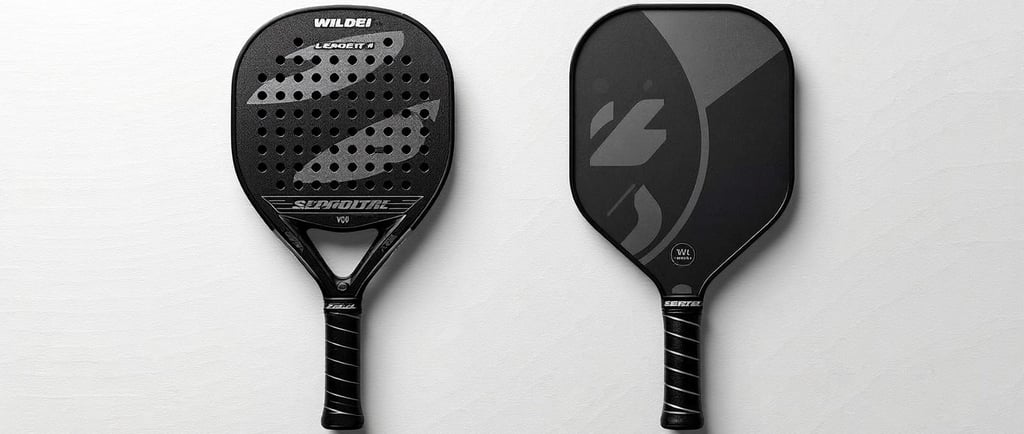
Although both sports use paddles or rackets without strings, the equipment is quite different.
Padel rackets
Padel rackets are:
Solid carbon or fiberglass
Perforated with holes
Slightly thicker than pickleball paddles
Designed to generate spin and control
There are also different racket shapes such as round, teardrop, and diamond, each designed for different playing styles.
Pickleball paddles
Pickleball paddles are:
Flat and solid
Usually made from composite materials
Lighter than padel rackets
Designed for quick reactions
Because the ball is plastic and lightweight, pickleball paddles focus more on touch and placement than spin.
Ball Differences
Another major difference between the sports is the ball.
Padel ball
Padel balls look very similar to tennis balls.
However, they are:
Slightly smaller
Lower pressure
Designed for controlled bounce inside the court
The softer ball helps create longer rallies.
Pickleball ball
Pickleball balls are completely different.
They are:
Hard plastic
Covered with holes
Much lighter than tennis or padel balls
Because of this, the ball travels slower through the air but can move unpredictably in windy conditions.
Style of Play
The playing style is where the two sports really diverge.
Padel style
Padel is very strategic and tactical.
Players frequently use:
Lobs
Glass rebounds
Angles off the walls
Team positioning
Points often involve long rallies and clever shot selection rather than outright power.
Pickleball style
Pickleball tends to be:
Faster paced
Played closer to the net
Based on quick reactions
The famous “dinking” rallies near the kitchen line are a core part of the sport.
These are soft shots designed to force mistakes from opponents.
Learning Curve
Both sports are known for being easy for beginners to pick up, but they feel different when starting out.
Why beginners like padel
Padel is beginner-friendly because:
The walls keep the ball in play
Doubles reduces court coverage
Rackets are easy to control
Even new players can have long rallies within their first session.
Why beginners like pickleball
Pickleball is also accessible because:
The court is small
The ball travels relatively slowly
The rules are simple
However, mastering the kitchen and soft game can take practice.
Fitness and Physical Demands
While neither sport is as physically demanding as full-court tennis, both still provide excellent exercise.
Padel fitness profile
Padel involves:
Short explosive movements
Lateral movement
Reaction speed
Strategic positioning
Because it’s played in doubles, the running distance is moderate.
Pickleball fitness profile
Pickleball involves:
Quick reactions at the net
Short bursts of movement
Less running overall
It’s often considered slightly lower impact, which is one reason it has grown rapidly among older players.
Popularity Around the World
Both sports are experiencing huge global growth.
Padel growth
Padel is booming across:
Spain
Italy
Sweden
Argentina
The UK
Many countries are rapidly building new padel clubs as demand increases.
Pickleball growth
Pickleball has exploded in popularity in:
The United States
Canada
Australia
It’s currently one of the fastest-growing sports in North America.
Which Sport Is Better?
There’s no single answer.
It depends on what kind of experience you’re looking for.
Choose padel if you enjoy:
Tactical rallies
Playing off walls
Team strategy
Longer points
Choose pickleball if you prefer:
Faster net play
Simpler court setup
Quick matches
Singles or doubles options
Many players actually end up enjoying both sports.
Final Thoughts
Padel and pickleball might look similar at first, but they deliver very different experiences on court.
Padel offers a strategic game with walls and longer rallies, while pickleball delivers fast-paced net exchanges with a unique plastic ball.
Both sports are social, accessible, and easy to learn, which explains why they are growing so quickly around the world.
Recommended for you
Best Padel Racket for Beginners


