
Round vs Teardrop vs Diamond Padel Rackets
LEARN
2/23/20265 min read


Round vs Teardrop vs Diamond Padel Rackets (Complete Shape Guide)
Choosing the right padel racket shape is one of the most important decisions you’ll make as a player. While weight, balance and materials all matter, the shape of your racket fundamentally influences power, control, forgiveness and playing style.
If you’ve ever felt confused by round, teardrop and diamond rackets — you’re not alone. Many players buy the wrong shape early on and end up struggling unnecessarily.
This guide breaks down the key differences between round vs teardrop vs diamond padel rackets, who each shape suits best, and how to choose the right one for your game.
Why Racket Shape Matters in Padel
Unlike tennis rackets, padel rackets are solid and their shape directly determines the sweet spot location, balance and power potential.
The right shape can:
Improve consistency
Reduce mishits
Boost confidence in rallies
Support your playing style
Speed up your development
The wrong shape can make padel feel much harder than it should be — especially for beginners.
👉 New to the sport? Read our Padel Techniques & Shots Guide to understand how racket choice affects your game.
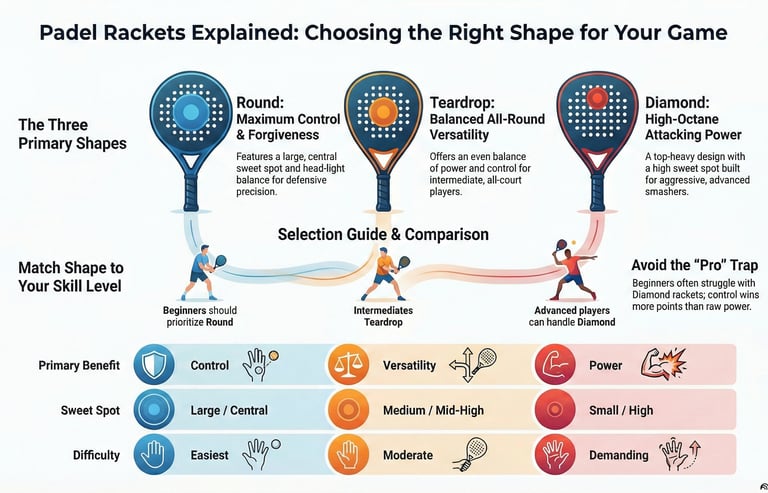
The Three Main Padel Racket Shapes
There are three primary padel racket shapes:
Round
Teardrop (also called hybrid)
Diamond
Each offers a different balance of power vs control.
Let’s break them down properly.
Round Padel Rackets
What Is a Round Racket?
Round rackets have a circular head shape with the sweet spot positioned in the centre of the face. They typically feature a low balance (head-light feel) and are designed for maximum control and forgiveness.
Key Characteristics
Large sweet spot
Low or medium balance
High control
High forgiveness
Lower natural power
Advantages of Round Rackets
Maximum Forgiveness
Round rackets are the most forgiving shape in padel. Because the sweet spot is large and central, off-centre hits remain relatively stable.
This is why beginners often improve faster with round rackets.
Excellent Control
Control is where round rackets truly shine. They make it easier to:
Keep the ball in play
Place shots accurately
Defend from the back court
Play controlled volleys
Arm-Friendly Feel
Most round rackets use softer materials and head-light balance, which helps reduce strain on the elbow and wrist.
Disadvantages of Round Rackets
Less natural power on smashes
Not ideal for aggressive attacking players
May feel underpowered for advanced users
Who Should Use a Round Racket?
Round rackets are best for:
Complete beginners
Defensive players
Control-focused players
Players prone to mishits
Anyone prioritising comfort
👉 See our top picks in Best Padel Racket for Beginners
Teardrop Padel Rackets
What Is a Teardrop Racket?
Teardrop rackets (sometimes called hybrid rackets) sit between round and diamond shapes. The sweet spot is positioned slightly above centre, and the balance is usually medium.
They are designed to offer a balanced mix of power and control.
Key Characteristics
Medium sweet spot
Even balance
Balanced power and control
Versatile performance
All-round playing style
Advantages of Teardrop Rackets
Best All-Round Performance
Teardrop rackets are the most versatile option. They allow players to:
Defend comfortably
Attack when needed
Transition to the net smoothly
Develop a complete game
This is why many intermediate players gravitate toward this shape.
Natural Power Boost
Compared with round rackets, teardrop models generate more power without becoming overly demanding.
You’ll notice easier depth on:
Bandejas
Viboras
Controlled smashes
Good Progression Racket
Many players move from round → teardrop as their technique improves. It’s often the sweet spot for improving club players.
Disadvantages of Teardrop Rackets
Less forgiving than round
Less explosive than diamond
Requires better timing
Who Should Use a Teardrop Racket?
Teardrop rackets suit:
Intermediate players
Improving beginners
All-court players
Doubles specialists
Players developing overheads
Diamond Padel Rackets
What Is a Diamond Racket?
Diamond rackets have an angular, top-heavy shape with the sweet spot positioned high on the racket face. They typically feature a head-heavy balance and are built for maximum attacking power.
Key Characteristics
Small sweet spot
High balance (head-heavy)
Maximum power
Lower forgiveness
Demands good technique
Advantages of Diamond Rackets
Maximum Smash Power
Diamond rackets are designed for aggressive players who want to finish points.
They excel at:
Flat smashes
X3 smashes
Viboras
Overhead winners
If power is your priority, diamond delivers.
Attacking Net Play
Advanced players who dominate the net often prefer diamond shapes because they generate extra punch on overhead shots.
Suited to Strong Players
Players with good timing and strength can unlock serious performance from diamond rackets.
Disadvantages of Diamond Rackets
Small Sweet Spot
This is the biggest drawback. Off-centre hits lose significant control.
Beginners often struggle badly with diamond rackets.
Less Forgiving in Defence
Because of the head-heavy balance, diamond rackets can feel slower when defending from the back court.
Higher Physical Demand
They require:
Better timing
Stronger technique
More consistent footwork
Who Should Use a Diamond Racket?
Diamond rackets are best for:
Advanced players
Aggressive attackers
Strong smash-focused players
Experienced tennis converts
Quick Comparison: Round vs Teardrop vs Diamond
Control
Best: Round
Balanced: Teardrop
Lowest: Diamond
Power
Highest: Diamond
Balanced: Teardrop
Lowest: Round
Forgiveness
Most forgiving: Round
Medium: Teardrop
Least forgiving: Diamond
Ease of Use
Easiest: Round
Moderate: Teardrop
Most demanding: Diamond
Best Player Level
Round: Beginner
Teardrop: Intermediate
Diamond: Advanced
How to Choose the Right Shape (Simple Rule)
If you’re unsure, follow this quick decision guide:
Choose Round if:
You’re new to padel
You want maximum control
You mishit occasionally
You prioritise comfort
You play mostly defensive padel
Choose Teardrop if:
You play weekly
You want all-round performance
You’re developing overhead shots
You want balanced power
You’re moving toward intermediate level
Choose Diamond if:
You’re an experienced player
You finish points at the net
You have strong smash technique
You want maximum attacking power
You rarely mishit
Common Mistake: Buying Too Advanced Too Early
One of the biggest errors new players make is jumping straight to a diamond racket.
It’s tempting — power sounds exciting — but in reality:
More power ≠ better performance
Forgiveness matters more early on
Control wins more points in padel
Most players improve faster by starting with round or teardrop shapes and progressing later.
Does Shape Matter More Than Weight or Balance?
Shape is the starting point, but the best racket choice considers:
Shape
Balance
Weight
Materials
Skill level
Think of shape as the foundation of the racket’s personality.
Two rackets with the same shape can still feel very different depending on materials and balance.
Final Thoughts
Round, teardrop and diamond padel rackets each serve a clear purpose — and choosing the right one can dramatically improve your experience on court.
In simple terms:
Round = control and forgiveness
Teardrop = balanced all-round performance
Diamond = maximum attacking power
For most players, especially beginners, starting with control and forgiveness will lead to faster improvement and more enjoyable matches.
As your technique develops, you can gradually move toward more powerful shapes that match your evolving playing style.
Recommended for you
Best Padel Racket for Beginners


