
Padel Rules Explained
2/14/20265 min read


Padel Rules Explained (Simple & Clear)
Padel is one of the fastest-growing racket sports in the UK and worldwide. It’s easy to start, highly social, and incredibly fun — but if you’re new to the game, the rules can feel confusing at first.
Unlike tennis or squash, padel uses glass walls, underarm serves, and a unique positioning system that changes how points are played. Understanding the rules early will help you avoid beginner mistakes, play with confidence, and improve faster.
This guide explains padel rules in simple, clear terms based on the latest FIP (International Padel Federation) regulations. By the end, you’ll understand scoring, serves, wall play, net rules, and the most common rule misunderstandings.
Why Understanding Padel Rules Matters
Many beginners can rally quickly, but matches often become messy because players aren’t fully clear on the rules. Knowing the official structure helps you:
Avoid unnecessary faults
Win more points through smart play
Communicate better with partners
Build confidence in competitive matches
If you’re just getting started, you may also find it helpful to read our Padel Techniques & Shots Guide to understand how the rules connect to real match play.
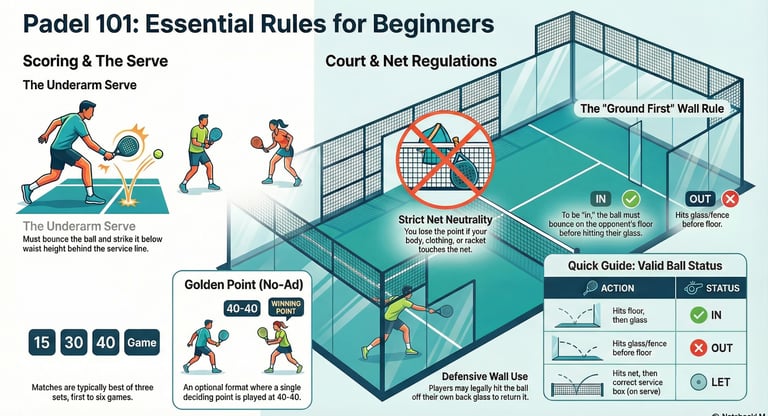
Scoring System in Padel
Padel scoring is almost identical to tennis, which makes it familiar for many players.
Standard Point Progression
Points progress in this order:
0 points = Love
1 point = 15
2 points = 30
3 points = 40
4 points = Game (unless deuce)
Matches are typically played as:
Best of 3 sets
First to 6 games (win by 2)
Deuce and Advantage (Traditional Scoring)
When both teams reach 40–40, the score is called deuce.
From deuce:
The next point won = Advantage
If the same team wins again → they win the game
If the other team wins → score returns to deuce
This is still the default official scoring format under FIP rules.
Golden Point (No-Ad Scoring)
Many modern competitions now use the golden point system, which speeds up matches.
Under FIP regulations, tournaments are allowed to adopt this format.
How golden point works:
Score reaches 40–40 (deuce)
Instead of advantage, one deciding point is played
The receiving pair chooses the side of the serve
Winner of that point wins the game immediately
Important: Many UK clubs still use traditional advantage scoring, so always confirm the format before your match.
👉 For equipment that supports consistent rally play, see our How to Choose a Padel Racket guide.
Serve Rules in Padel
The serve is one of the most misunderstood parts of padel. It is deliberately designed to start the rally rather than dominate the point.
Correct Starting Position
At the moment of serving:
Both feet must be behind the service line
The server must stand between the centre line and side wall
At least one foot must remain in contact with the ground
The player cannot walk, run, or jump during the serve
Stepping on or over the service line before contact is a fault.
How the Serve Must Be Hit
The padel serve must follow these rules:
Must be underarm
Ball must bounce first
Contact must be below waist height
Serve diagonally into the opponent’s service box
If the ball hits the net and lands correctly in the service box, it is a let and replayed.
Serve Sequence
First serve from the right side
Alternate sides each point
Two serve attempts allowed (like tennis)
Net Rules in Padel
Net play is where most points are won — but there are strict rules to follow.
Basic Net Faults
You lose the point if:
Your racket, body, or clothing touches the net during play
You cross the net to hit the ball before it comes to your side
You interfere with opponents’ ability to play the ball
Can You Reach Over the Net?
Yes — but only after the ball has crossed to your side first.
This most commonly happens when:
The ball bounces back over the net after hitting the back glass wall
You reach over to finish the point
Touching the net during this action is still a fault.
Net Height
For reference:
Centre height: 88 cm
Post height: 92 cm
Wall Rules (The Feature That Makes Padel Unique)
The glass walls are what truly separate padel from tennis and squash.
Understanding wall rules is essential if you want to progress beyond beginner level.
When the Ball Is In Play
The ball is valid if it:
Bounces on the opponent’s court first
Then contacts the glass walls
This is standard defensive play in padel.
When the Ball Is Out
The ball is out if it:
Hits the wall before bouncing on the ground
Hits fencing directly on the full
Bounces twice on the ground
Using Your Own Walls
Players are allowed to:
Hit the ball after it rebounds off their own back or side glass
Use the walls defensively to extend rallies
This is a core skill in padel.
Common Rule Misunderstandings (Beginner Mistakes)
Many new players lose easy points due to simple rule confusion. Here are the most common mistakes.
Misunderstanding #1: Only One Foot Behind the Line
Incorrect.
Under official rules:
Both feet must start behind the service line
You cannot step on the line before contact
This is one of the most frequent beginner faults.
Misunderstanding #2: The Serve Should Be Powerful
Not true.
In padel, the serve is designed to:
Start the rally
Allow the serving team to approach the net
Consistency and placement matter far more than power.
Misunderstanding #3: You Must Hit the Ball Before the Wall
Incorrect.
In many defensive situations, it is better to let the ball hit the back wall first. This gives you:
More time
Better positioning
Higher-percentage returns
Misunderstanding #4: Smashing Wins Points Easily
New players often over-smash.
In reality:
Smart lobs win more points
Controlled overheads maintain net position
Poor smashes often give opponents the advantage
Misunderstanding #5: Golden Point Is Always Used
Not always.
Remember:
Advantage scoring = official default
Golden point = optional tournament format
Club play varies widely
Always confirm the match format before starting.
Doubles Positioning Rules
Padel is almost always played in doubles, and positioning is part of the tactical rule structure.
When Serving
Server’s partner can stand anywhere on their side
Receiving partner can stand anywhere on their side
During Rallies
Teams should generally:
Defend together near the baseline
Attack together at the net
If you advance alone, you leave gaps — a common beginner error.
Quick Beginner Rule Checklist
Before your next match, remember:
Serve underarm and below waist height
Both feet behind the service line
Ball must bounce before hitting walls on return
Do not touch the net
Confirm whether you’re playing advantage or golden point
Final Thoughts
Padel rules are simple once you understand the core structure. The sport rewards smart positioning, patience, and teamwork far more than raw power.
By mastering the fundamentals — especially the serve rules, wall play, and scoring formats — you’ll avoid common beginner mistakes and enjoy the game much more.
If you’re serious about improving your on-court performance, your next step should be choosing equipment that supports control and consistency.
Recommended for you
Best Padel Racket for Beginners


