
Left Side vs Right Side in Padel
LEARN
2/25/20264 min read
Left Side vs Right Side in Padel (Roles Explained)
If you’ve started playing doubles padel, you’ve probably heard players talk about the left side and right side — and you may have wondered why it matters.
Unlike some racket sports, padel doubles has clearly defined positional roles. While both players share the court, the left and right sides typically demand different strengths, responsibilities and playing styles.
Understanding where you fit best can dramatically improve your performance, teamwork and match results.
In this guide, we’ll break down the key differences between the left side vs right side in padel, who each position suits, and how to decide where you should play.
Why Positioning Matters in Padel Doubles
Padel is predominantly a doubles sport, and positioning is one of the biggest tactical factors in winning matches.
Because most players are right-handed:
The left-side player usually covers more attacking balls in the middle
The right-side player often plays a more controlled, setup role
Overheads and forehands naturally favour the left-side player in many situations
This doesn’t mean one side is “better” — but the roles are different.
Choosing the right side for your skillset helps you:
Win more points at the net
Avoid confusion with your partner
Maximise your strengths
Improve team chemistry
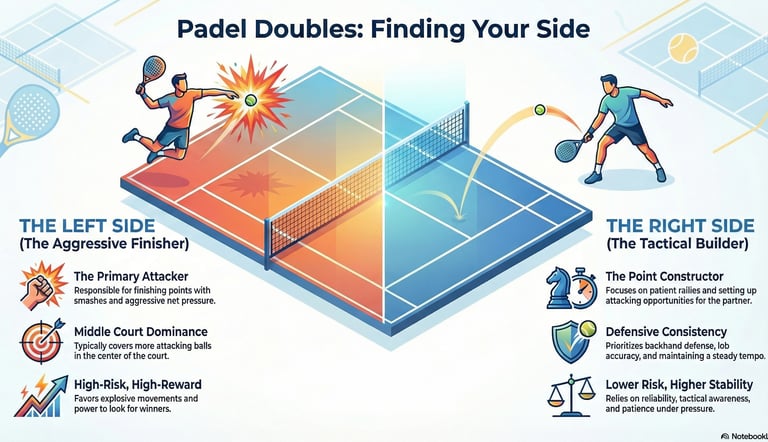
The Left Side in Padel
Typical Role
The left-side player is usually the more aggressive, attacking player in the pair.
Because forehands typically dominate the middle for right-handed players, the left-side player often gets more opportunities to:
Finish points
Hit smashes
Attack high balls
Apply pressure at the net
This is why many advanced pairs place their stronger player on the left.
Key Responsibilities
Players on the left side typically:
Take more overheads in the middle
Finish points at the net
Attack weak lobs
Look for winners
Apply offensive pressure
You’ll often see the left player stepping across the centre to take control of attacking balls.
Strengths Needed for the Left Side
The left side usually suits players who have:
Strong overheads and smashes
Confident forehand
Good aggression at the net
Quick reactions
Ability to finish points
Power and decisiveness are big advantages here.
When the Left Side Works Best
The left side is ideal if you:
Like attacking padel
Enjoy finishing points
Have a strong smash
Are comfortable poaching in the middle
Play aggressively at the net
Many former tennis players naturally gravitate to the left side for this reason.
The Right Side in Padel
Typical Role
The right-side player is usually the more consistent, control-focused player.
While the left player often finishes points, the right player typically helps build them.
This role is hugely important — strong right-side players make their partners look good.
Key Responsibilities
Players on the right side typically:
Build rallies patiently
Defend consistently from the back court
Set up attacking opportunities
Control tempo
Cover the line on their side
The right-side player often touches the ball more in longer rallies.
Strengths Needed for the Right Side
The right side suits players who have:
Excellent control
Strong defensive skills
Good lob accuracy
Tactical awareness
Consistency under pressure
Patience and reliability are key traits here.
When the Right Side Works Best
The right side is ideal if you:
Prefer consistency over power
Enjoy constructing points
Have a strong backhand defence
Play a patient tactical game
Are newer to padel
Many beginners naturally start on the right side.
Left Side vs Right Side: Key Differences
Attacking Responsibility
Left side: Primary attacker
Right side: Point builder and stabiliser
Shot Profile
Left side: More smashes and winners
Right side: More lobs and controlled shots
Risk Level
Left side: Higher risk, higher reward
Right side: Lower risk, higher consistency
Physical Demand
Left side: More explosive movements
Right side: More sustained rally work
Typical Player Type
Left side: Aggressive finisher
Right side: Tactical controller
Important Note: It’s Not Always Fixed
While these are typical roles, padel is dynamic.
In modern padel:
Players often switch temporarily
Both players must defend well
Communication is essential
Flexibility improves partnerships
At beginner and club level especially, rigid positioning matters less than good teamwork and clarity.
What About Left-Handed Players?
Everything changes slightly when a left-handed player is involved.
The ideal pairing is often:
Left-handed player on the right side
Right-handed player on the left side
Why?
Because this keeps forehands in the middle, giving the pair maximum attacking coverage.
Left-right handed combinations are often very effective in doubles padel.
Which Side Should Beginners Play?
For most new players, the right side is usually the best starting point.
Reasons:
More forgiving role
Focus on consistency first
Less pressure to finish points
Better for learning positioning
Builds tactical awareness
Once your overheads and attacking confidence improve, you can experiment with the left side.
Signs You Should Move to the Left Side
You may be ready for the left side if:
Your smash is becoming reliable
You naturally look to attack
You dominate the net comfortably
You finish points consistently
Your partner prefers a control role
Progression is normal — many players move left as they improve.
Common Positioning Mistakes
Both Players Trying to Be the Attacker
This causes:
Collisions in the middle
Poor court coverage
Rushed decision-making
Good pairs have clear role balance.
Standing Too Wide
Players often hug the sideline too much.
Better positioning:
Stay compact as a pair
Protect the middle
Move together
Maintain net pressure
Poor Communication
Many lost points come from hesitation.
Always call:
“Mine”
“Yours”
“Switch”
Clear communication is a major competitive advantage.
How to Decide With Your Partner (Simple Test)
Ask these questions:
Who has the stronger smash? → likely left side
Who is more consistent defensively? → likely right side
Who prefers attacking? → left side
Who prefers control? → right side
Who handles pressure better at the net? → left side
This simple conversation solves most positioning debates.
Final Thoughts
In padel doubles, the left and right sides serve different but equally important roles.
In simple terms:
Left side = attacker and finisher
Right side = controller and builder
Neither role is “better” — the best partnerships combine controlled consistency on the right with decisive attacking on the left.
If you’re newer to the sport, start by mastering consistency and positioning. As your confidence grows, you can experiment with more aggressive roles and discover where your natural strengths lie.
The goal isn’t just to pick a side — it’s to build a balanced partnership that wins points together.
Recommended for you
Best Padel Racket for Beginners


