
How to Play the Bajada
LEARN
7/9/20268 min read
How to Play the Bajada: The Shot That Controls The Back Court
Stop defending from the baseline and start attacking from it.
Most beginners see the back glass as a problem to solve — a place where things go wrong and you need to escape from quickly.
Intermediate players see it as an opportunity.
The bajada is the shot that makes that shift happen. It's the one technique that transforms you from someone who's stuck at the back of the court into someone who's applying pressure from there.
Here's the honest truth: a well-played bajada from the back glass often forces more errors than a smash from mid-court. Your opponents have less time to react. They're already deep on their own court. A controlled bajada that lands low and deep leaves them almost no options.
This is the shot that changes how you think about defending.
What The Bajada Actually Is
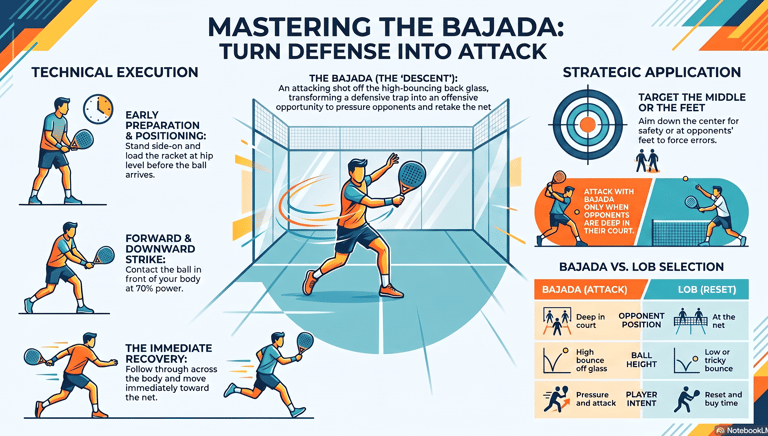
The bajada is a controlled attacking shot played when the ball bounces off the back glass and sits up in front of you.
The name literally translates to "the descent" in Spanish — which is perfect because the ball comes down off the glass and you're redirecting it forward with control and placement.
Key distinction: This is NOT a lob. It's not a reset shot. It's an attacking shot played from the back of the court.
The goal is to hit a ball that lands low and deep in your opponent's court — ideally at their feet or forcing them to play from an uncomfortable position.
Think of it as the opposite of a lob. A lob pushes your opponents back and gives you time. A bajada pushes your opponents back AND puts them under immediate pressure because the ball is coming at them with pace and control.
Why The Bajada Matters
Here's the tactical reality at club level: most beginners can keep a rally going. Most can lob. Most can smash when given the opportunity.
Very few can attack from the back of the court.
This is the gap between good club players and great ones.
When your opponents hit a lob to your back glass they expect one of three things:
You'll play a defensive lob back
You'll retreat further and struggle
You'll rush forward and make an error
They don't expect you to attack them from the back.
A bajada that lands at their feet or forces them into the mid-court is disruptive. It's the last thing they're prepared for when they've just pushed you back.
This single shot transforms your game from "I survive at the back" to "I create problems from the back."
The Bajada Vs The Lob — The Critical Difference
Both shots start from the same position — ball bouncing off the back glass. But they're fundamentally different in intent and execution.
The Lob:
High trajectory
Deep landing
Goal: reset the rally and buy time
Pace: controlled, slower
Situation: when under pressure, when opponents are at net
The Bajada:
Lower trajectory
Deep landing but with forward pace
Goal: attack and create pressure
Pace: controlled but accelerated
Situation: when you have time, when opponents are vulnerable
The lob says "I'm not ready for this rally yet — give me time."
The bajada says "I'm attacking you from here."
The physical difference is subtle but important: the lob comes off the racket going upward. The bajada comes off the racket going forward. Both land deep but one is defensive reset, one is aggressive attack.
The Technical Breakdown
Step 1 — Read The Ball Off The Glass
This is the foundation. If you don't read the bounce correctly the rest doesn't matter.
The ball bounces off the back glass. Watch it come off. Most beginners panic or rush this moment.
Don't.
Let the ball settle off the glass. You have more time than you think. A good bounce off the glass actually gives you a clearer read than a ball bouncing off the floor.
The ball height after bouncing off the glass tells you everything:
High bounce = you have time and options
Low bounce = you need to hit down through it
Fast bounce = the glass was hit with pace, you need quick reflexes
Slow bounce = the ball sat on the glass, you have time to set up
Take a half-second to read this. It changes how you approach the shot.
Step 2 — Position Your Feet
Position yourself side-on to the ball — not facing it head-on.
Your feet should be shoulder-width apart with your weight balanced. You're not in a defensive scramble position. You're in an athletic ready position.
If the bounce is high you have time to step into the shot. If it's low you're playing it from where you stand.
The key is balance. You want your weight centered so you can generate pace through the shot without losing control.
Step 3 — Prepare The Racket Early
Don't wait for the ball to arrive before preparing your racket.
Load the racket early — bring it back to your hip level or slightly higher. This is a more compact preparation than a full groundstroke but more loaded than a volley.
You're essentially preparing like you would for a mid-court groundstroke — because that's essentially what this is, just played from the back glass.
Step 4 — The Contact Point (Forward And Down)
This is where bajada technique differs from a lob.
Contact the ball in front of your body — slightly ahead of your natural contact point. This forward contact creates the forward trajectory rather than the upward trajectory of a lob.
The racket should be driving forward and slightly downward through contact — not upward like a lob.
The angle is subtle but it's the difference between attacking and defending.
Step 5 — Drive Through The Ball
The bajada requires you to drive through contact — not guide the ball.
You're generating pace but maintaining control. It's not a full power drive like you'd hit from mid-court. It's controlled acceleration.
Think of it as a 70% power shot — enough pace to put pressure on your opponent, not so much that you lose the court or the ball goes long.
The follow-through should be forward and across your body — similar to a groundstroke follow-through.
Step 6 — Recover Your Position
After playing the bajada move immediately forward.
You've just attacked from the back. Now move toward the net before your opponents can stabilize their position.
This is the moment where the bajada creates its real value — your forward movement combined with the pressure of the shot often catches opponents unprepared.
Where To Aim Your Bajada
Down the middle is your safest target.
A bajada down the middle lands deep, creates confusion about who should take it, and gives you the best chance of it staying in the court.
At their feet is the aggressive target.
If you can place a bajada so it lands at waist or knee height a few metres inside their baseline they're forced into a defensive posture immediately. They have very few good options from there.
This requires precision. In practice before attempting this in matches.
Wide into the corner is the tactical target.
A bajada into the far corner forces your opponent to chase it and potentially hit from an awkward position. But this is advanced — requires good court sense.
At club level stick with down the middle for reliability and at their feet for aggression. Those two targets will cover 90% of situations.
The Most Common Mistakes
Mistake 1 — Playing A Lob When You Should Play A Bajada
You read the situation as defensive when it's actually attacking.
The ball bounces off the glass with good height. Your opponents are deep in their court. You have time and options.
Yet you play a lob.
This is safe but it's also giving up an attacking opportunity.
Fix: Before you play off the back glass ask yourself "can I attack this or should I reset?" If the answer is "I can attack," do it.
Mistake 2 — Contacting Too High
You hit the ball above shoulder height and it goes long or lacks control.
The bajada requires forward contact point — not an upward one.
Fix: Contact the ball at waist to chest height — driving forward through it rather than upward.
Mistake 3 — Not Driving Through The Ball
You're guiding the bajada rather than hitting it.
The result is a slow ball that your opponents can comfortably handle.
Fix: Commit to the shot. Drive through with controlled pace. 70% power, not 30%.
Mistake 4 — Failing To Recover Forward
You play a bajada and then stand at the back of the court.
Your opponent handles it comfortably and now you're still at the back but they're advancing.
Fix: Play the bajada and immediately move forward. The forward movement is part of the shot sequence.
Mistake 5 — Attempting A Bajada In Situations That Demand A Lob
Your opponents are at the net. The ball bounces off the glass.
You try a bajada and they smash it away easily because they're perfectly positioned.
Fix: The bajada only works when your opponents are vulnerable. If they're already at the net, lob instead.
The Bajada Drill
Build this into your practice routine — 5 minutes per session.
Setup:
Stand at the back of the court near the back glass. Partner feeds balls that bounce off the back glass in front of you.
Execution:
Play a bajada to each ball.
Focus on:
→ Forward contact point — not above your head
→ Controlled pace — 70%, not 100%
→ Placement down the middle or at their feet
→ Immediate recovery forward
Progression:
Week 1: Just focus on keeping the ball in the court and driving it forward.
Week 2: Add consistency — make 8 out of 10 bajadas land deep in their court.
Week 3: Add placement — consistently place them either down the middle or at their feet.
Week 4: Add game speed — partner increases feed speed and you adjust.
This drill is deceptively simple but it's the foundation of a reliable bajada.
When To Play The Bajada In A Match
Play a bajada when:
→ The ball bounces off your back glass with good height
→ Your opponents are deep in their court (not at the net)
→ You have time to set up (not a scramble situation)
→ You want to attack rather than reset
Play a lob instead when:
→ Your opponents are already at the net
→ You're under serious time pressure
→ The bounce is very low or tricky
→ You need to reset and buy time
The decision usually becomes clear once you start using the shot. After a few matches you'll develop an instinct for when the bajada is the right play.
The Bajada's Real Value
The biggest misconception about the bajada is that it's about winning points directly with the shot.
Sometimes it does. Often it doesn't.
The real value is the pressure it creates and the disruption it causes.
When your opponents push you to the back glass expecting to reset their position and instead get attacked — it changes their tactical approach.
They start hesitating on their lobs. They stop pushing you back as aggressively because they know you have options from there.
This psychological shift is worth more than any individual point.
The bajada transforms the back glass from a defensive zone into an attacking zone.
Master it and your opponents will notice.
Found this useful? Subscribe to the Club Padel & Co newsletter for weekly guides, racket reviews, and tactical tips for everyday players.
Recommended for you
Best Padel Racket for Beginners


